
Reviewed by William Rowe in Tripwire 23
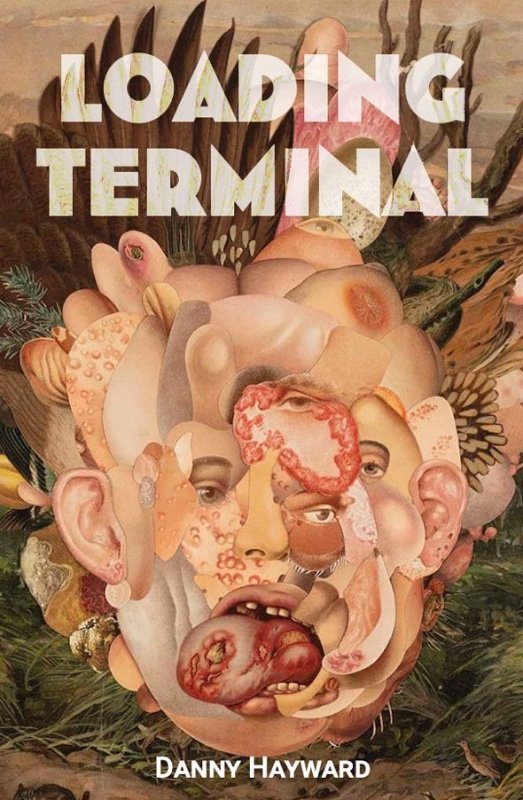
Seeing not-seeing: Loading Terminal
We know how to make the truth appear in theory, but to know what can be done in our present situation so as collectively to change it requires altering the senses so as to fully engage with present time and space. Danny Hayward’s wager is not to find a method for making the un-seen visible—conspiracy theories being a form, albeit reductive, of that wish—but to actually see the causes of our own not-seeing, to start there, as a means of discovering the alterations of perception that are necessary for grasping present time and space. His book is not concerned with specialist knowledge but with the intuition that what bars our way into the real present, i.e. into what’s actually happening, can be made visible. What language, what images will serve?
If we ask ourselves what might characterise this thinking we notice that the work begins with emotional pain as a question of real time and space; there is present time and there is what blocks our access to it:
Loving someone who has ‘advanced’ cancer demands
that we shut offthe future in a kind of instinctive solidarity. We are
here now. The portalwe need to pass through leads into this present. There
are so manythings that prevent us from going through it.
‘Metal detectors’ for one. Instead of the symbolic ‘gate’ that belongs to ‘the history of poetry and of mythology-religion’, we are confronted by the actual enforced borders between people. Instead of literary gates, it’s ‘black and Asian council workers’ who operate the metal detectors that keep us out in daily life; space privatised by power, and no easily identified white male enemy.
What’s present in LT are ‘objects without interiors’, without the dream that exists inside objects of desire. There’s ‘a vast iron roof’. ‘Certain images drew me on the vast iron wall’. Which is to say that when the fantasies of property are stripped away, the self’s attraction towards a certain fixed limit can start to be seen; upon that wall it’s drawn, represented. This turn is not about giving up the feeling of individual being, but about finding the outside of inwardness so as to rigorously track the contours of inner life as they are laid down by the operations that control the visible and the possible.
One day a lump appeared in my body, I put on some
clothes made byslaves & went out
there for nothing in particular. I was soaked by the
sea it was inbred byentrepreneurs
to enhance its wetness its vastness and in
particular its character as aboundary
‘Inbred’ speaks of how the sensual properties of things are shaped into meaning by external social forces: vastness – wetness – boundary; how the sea is made into the experience of the national border and from there into the operation of racism as constitution of the social. To see inner experience as something produced requires placing oneself inside, inside the forces that are shaping the self. And that in turn demands humility, non-mastery; and an attitude to language that would follow from that.
But is that all, is there something not included, a remainder to this equivalence of inner experience and the produced environment, something that leaks out of this conception? That nothing other than waste and surplus bodies should be left over from the economic definition of reality is the desire of neoliberal capitalism, the operation of its totalising ideology. But when LT confronts the visible world back with its production, the equation is not exact. Something is left over; another scene, the negative of appearances, their other side:
in the middle of that sea I met the image of myself it
askd me how is itthat we are able
to see the hatred of appearance wrap itself in reality
when in reality all weever wanted
was to appear, and why have we concealed that reality
behind this vastiron wall
We are not in the territory of Michel Foucault’s thought, which sees in prison the way in which the gaze of social control is produced. Danny is asking how, inside the capitalist production of reality, we produce inside ourselves the thing that stops us seeing what we’re doing. Or, to say it differently, what organises our senses into a sense of general paralysis, a feeling that there’s nothing to be done? As if the situation of the disabled in this society were the situation of all who desire justice.
What if anger at the way things are becomes ‘the hatred of appearance’, paired with the impulse to destroy the world as it exists: what person who desires justice has not felt this way at some point? But the poem asks how can here be this ‘hatred of appearance [ . . . ] when in reality all we ever wanted / was to appear?’ The answer depends on what wanting to appear means. I think it means quite simply to want the world to sustain our desires, which clearly in the current situation it doesn’t. But we have to take on a more difficult meaning, which would require recognising a ‘because’ and not just a question: it’s the wanting to appear, to see ourselves as part of the world, the very drive to see, that’s involved in creating the wall. Obviously the wall is built of social conditions that exclude us, but we have also produced it, it’s an embodiment of a not-seeing that hides itself from us. Perhaps William Blake’s statement is relevant: ‘the bounded is loathed by its possessor’ (The Marriage of Heaven and Hell); thus the wall would be a place of reduced reality. What could be put in place of ‘the hatred of appearance’? It doesn’t suffice simply to say love, love of the world, since a real resistance to the disaster of capitalist reality would require a work of love that releases the senses from the social forces that currently shape them. To see not-seeing is an opening, an anti-practice that’s neither utopian nor dystopian but a way of working that seeks to fully open itself to present time and space, however difficult, however far from any form of hope, that might be.
If there’s no image capable of embodying desire for change, and if the ‘vast iron wall’ then becomes the defining image, the one that shapes the faculty of imagination, what would follow? LT looks from the image that’s cast, from the place upon which it is cast, the iron wall. This is its singular action. To accomplish that, an understanding of how that place is produced is necessary, which would not be understanding in the abstract but to have recognised the forces that produce space (‘I was soaked by the sea it was inbred by entrepreneurs’). But this recognition offers no hope, no ‘tiny red bit of negation’ only ‘tears of allegoric rage’. But the poem does not stop at despair, the dominant feeling of the present situation, it pushes all the way to the limit of despair:
the image sweeps past me in tears of allegoric rage, & in boredom I sweep past it it
travels toward meaning but I travel towards meaning-
death
Here is the particular image referred to: ‘when all things are changed, even as in ancient times, / where 1000s of these rivers in veins of blood pour silently down the mountains’. This Biblical image (Revelations: 16) echoes down corridors of history; in recent times it came out of the mouth of the well-known British racist, Enoch Powell. But the poem, having failed to find ‘a tiny red bit of negation’, is not satisfied with apocalyptic imagination of mass death as an alternative. Instead, there’s boredom, i.e. desiring something else, other than ‘allegoric rage’. Despair, taken to its limit, yields up its conception. The ‘allegoric rage’ which results from it makes its way towards meaning, but that particular direction of meaning belongs ultimately to apocalypse, the great book of death mobilised, of resentful destruction, ancient version of ‘this hip hatred of appearances’. The poem is critical of itself at this point, and doesn’t our imagination of revenge for hurt—who doesn’t want revenge at some point?—also qualify for that same critique of the will to destruction? And then also, what might be an untruth that’s specific to allegory as a form of meaning?
But first, let’s consider its truth. For Blake, ‘Allegory addressed to the Intellectual powers while it is altogether hidden from the Corporeal Understanding is my definition of the Most Sublime Poetry’ (A Vision of the Last Judgment, 1810, in Blake’s Poetry and Designs, 2008). In Blake’s thinking, then, allegory is an alternative to understanding via the senses, which may sound like a repressive stance until we locate ‘Corporeal Understanding’ as being the reduction of reality, in the common phrase, to things you can touch and see, i.e. bourgeois materialism or what Mark Fisher has called Capitalist Realism. We can turn that round and say that the senses as here referred to are equivalent to current neo-positivism, CBT, cognitive science married to self-improvement, Jordan Peterson, etc., i.e. that this specific organisation of the senses, which Blake finds in Locke and Newton, is equivalent to ideology and, more exactly, to the way in which reality has in our time become ‘its own ideology’ (Theodor Adorno, The Culture Industry). Allegory, in this context, would be a way of moving against reality.
Danny takes us further along that pathway. If allegorical figures arise out of the necessity to wrench thought and language away from their dominant forms, dominant insofar as they naturalise reality, if allegorical images can gain that leverage, nevertheless the meaning towards which they ‘travel’ does not prevent the ‘I’, which is also an ‘us’, from traveling towards ‘meaning-death’, and that doesn’t speak simply of the death of meaning but also expresses that what meaning there is consists of death; that would be the substrate of ‘allegorical rage’.
Danny’s attitude to language shows in his use of older spelling (such as ‘askd’) and of forms of expression that recall earlier time alongside contemporary ones (as in ‘I looked out upon 1000 walkthru security gates’). These work as interruptions to the smoothed out time of contemporary capitalism. The poem extends its thinking about language at the level of its material form: the fact that contrary to the normative typography of poetry it is printed not down but across the page, in landscape format. In order to read it you have to rotate the book in 900. A commentator on Blake’s poem Milton writes, ‘In its most developed state, Blake’s sublime of the text is no longer a matter of words on walls, inscriptions on indeterminate ground, but of walls made out of words.’ (Blake’s Poetry and Designs, 2008) ‘Indeterminate ground’ describes the conventional page of poetry which takes no responsibility for its relation with the actually occurring space from which it is abstracted; on the contrary, the wall of words occurs in DH’s poem as the machinic filling of the width of the page, the ‘iron wall’ as wall of words, but not abstracted from material walls—the commentator’s dismissal of ‘words on walls’ falls into that kind of abstraction. The prose lines, made to fill to the letter an exact width, embody technical decision and labour of typesetting, as opposed to the organisation of the digital ‘page’ by algorithms. Once we see it that way, there’s been a decisive alternation of reading space; we are moving our eyes as along a physical-spiritual surface, in this case a wall, a wall that stands at the place where capitalist commerce, the faculty of vision and ‘the hatred of appearance’ intersect.
On the other side, the allegorical torsion applied to image-creation in language, by dint of making not-seeing seen, reverses that process; it reverses the production of environment by capital, such as the ‘development’ of Tottenham in order to erase the scene of rioting, in turn part of the control of the visible in a context of potential urban warfare. Fashion is also part of the process (‘Our Originals boyfriend hoodie’), the fashion fetish contributing to the production of the great wall. There’s a particular politics of writing and reading in this. Walter Benjamin, in his essay ‘The Author as Producer’, urges us to find the political meaning of an artwork not so much in its representations as in in its technical process, specifically where this means what is the relation of its artistic technique to the technology operating in a given society. We can say that in terms of technique key elements in play in LT are processes of printing and reading along with their relation to physical space. In normal reading the page with its white borders is cut off from surrounding space; LT reverses that: the reader’s eye encounters blocks of text, as if they were parts of a wall that continues above and below the first and last lines. The usual relationship between the act of reading and the space in which it occurs has been turned round so as to face towards really existing, shared relationships with space, including the way monetisation makes the relation to space oppressive. The wall of words, then, is a place of discord between oppressive space and the struggle inside and against it.
These aspects of technique and production have some bearing on the difficult question of how far the ‘we’ of the book works to exclude or include people who have not had access to the cultural knowledge and technical capacities its readers would need to have at their disposal. The question how far the technical alteration of reading goes, how far the way it communicates intersects with the political, would require further thinking through, including a discussion of Danny’s earlier work and work by other poets. I leave it as a question. In terms of distribution, Danny’s previous books of poetry were mostly inexpensively produced as free copies. The current commercial edition affords wider distribution. That contradiction has at present no solution, as long as a book is to be a physical object. In terms of thought, I ask myself whether LT wagers itself upon the hope of a historical exit from ideology— another question.
The operation of the allegorical image is radically contradictory; it blocks and it communicates:
Certain images draw me on an image of what cleans
an image of whatpollutes an image
of what blocks and what communicates I stood in the corroding thin
rain, an image of
myself flickering in the particle ‘of’, in greenhouses
of negation:pseudoradical
The question about communication would include the images in the lines just quoted: do they merely replicate reality’s self-replication or do they reveal something else? The self appears/disappears in the small word ‘of’, a particle of language. This ‘of’ joins an image to something (‘an image of’). The more general question of the relation of language to the world comes in here. The self flickers in and out of visibility exactly on that pivot, which is also the pivot of despair, compromised by its attraction to the pseudo-radical politics of what we can recognise as greenwashing, itself in this situation a case of wanting to appear.
Danny’s allegorical figures repeat without change, this is their radical but also socially produced limitation: ‘I looked out upon 1000 walkthru security gates & a thin rain scanned me’. Scanning speaks of how present time is becoming a digital-algorithmic rendering of itself. The allegorical figures repeat (the thin rain, for example), time is not felt to be passing inside them. This makes them iconic: they stand out against time-as-change. In a contrary sense they communicate a blocked situation, a present in which the negation that would bring change feels impossible. Would something else have been ‘better’? Is there a theory that can guide us? All thought must cross that allegorical ditch, where allegory at its base is the figure of social change closed down; this is something that emerges at the point where we don’t identify with that closure but find the capacity to see our place inside it.
I’ve mentioned Blake. We could start to think that in Blake’s work there is frequently a renewal of desire, and that in LT there’s no such confidence in desire. But is it a question of desire, when ‘the giant ore mines are just mms // away we control all relations, there are no physical limits’? The content of that last phrase is the metaphysics of capitalist production, the fantasy of growth, of infinite accumulation. The allegorical figures occupy the space that used to be that of metaphysics: so we get Marx and Engels’s The German Ideology in reverse, instead of the metaphysical brought down to earth, here the capitalist earth has been turned back into its metaphysical ground.
The lines quoted above belong to Part II of LT, where the invariant typographical controls of prose give way to song-lines of hope and lament. Here are some further phrases from this part: ‘a new era begins with / new words you don’t know’; ‘a complete redefinition of all interiors’; ‘shove your art’; ‘shove that liberalism’; ‘metal detectors in the skies / vast oval, billions of senses, a nightshift beneath the elevators’ vast corridors: // etc.’ Utopian anticipation of the future collides head-on with an opposite image of lockdown, lockdown as spreading capture of the senses, anticipating the marriage of AI and the destruction of the earth; ‘forest death in a vast meaningless engine of thought’.
In part III, LT touches bottom—a misleading expression if destruction can always go further; where is the limit?
the granite care home wanks inside our head like
a dog we haveeaten from the alien art warehouses and in the cold
zones of molecularclouds I know
‘I cannot see’ is scorched into my retinas, like rubies
in the phone boxoutside
Not-seeing becomes itself something seen (‘you will see not- seeing’— Raúl Zurita), and so the operation of the visual apparatus is turned round towards its production of exclusion. We know that visibility operates as a means of external/internal control, that being the dominant definition of reality it sets the limit of what’s possible. Supposing you turn that round, and start to see the not-seeing which this regime of visibility produces, and then let the sphere of not seeing take time and space into itself and be peopled by images—that seems to be the principle way that allegorical images are made in LT.
Then the forces which rule visible reality would be present inside the sphere of not-seeing; the poem turns those forces into thought- figures and by so doing pushes against the thresholds of the apparatus of control. In other words, what produces and sustains the allegorical is its capacity to express particular forces that rule visible reality, making not-seeing an object, a phenomenon, and in the same act making its beyond, which Blake calls vision, a possibility even if existing only as scattered points of jewel-light—a traditional embodiment of visionary seeing. ‘Fable or Allegory is formed by the Daughters of Memory. Imagination is Surrounded by the daughters of Inspiration who in the aggregate are calld Jerusalem [ . . . Allegories] relate to moral virtues [which] do not exist.’ (Blake, 2008) In other words, allegory draws its material from the past, and vision or imagination is utopian anticipation of the future, location of hope. But for Danny, the jewel-light of vision has been scattered, the thick impossibility of change and the food of paradise have been scrambled into one: ‘“I cannot” scorched into my retinas, like emeralds on the pavement outside are you cast out / from Heaven every junkie knows you are not’. Baudelaire’s ‘artificial paradises’ are still paradises, even if scattered even if located in the same place as addiction.
Allegory, historically, was for the 17c writers called Ranters a prime expression of rebellion against bourgeois suppression of social revolution. Allegory meant other-saying, in the sense of saying what’s not supposed to be said. Abiezer Coppe sees his own text as the instrument indicated by its title: A Fiery Flying Roll, published in 1649, condemned by parliament and burnt in 1650. If that was its subversive use by the Ranters, why has allegory become, for Danny, part of not-seeing? A provisional conclusion would be that the penetration of capital (as money and as ideology) into every sphere of life has proceeded so far that it appears to have no outside. The poem’s non-exclusive logic (proceeding by both/and rather than either/or) operates in its syntax in such a way that opposites run into each other instead of repelling each other. Perspective, the separation and ordering of objects in space according to a ‘point of view’, is also annihilated, as with a very wide-angle lens; everything is as close as everything else. There’s no subjective gaze working to bring some hope of change to the way things simply are. The damage which besets us exists as much inside the cells of the body as in the dead substance of damaged mutuality, ‘like waste which accumulates in our cells like shit in a toilet / like this feeling of something always bubbling beneath the surface of an / image’. This section of LT acknowledges its least ideal desire:
pulsing through you
like a smashed emerald on the pavement, far below
the desire to make allour
lives better
the wish not to be like them, like waves across the
phantom seaseparates and spreads out towards the shore, far below
‘benevolence’
The ‘them’ referred to here are liberals. The section ends with affirmation of pure rage, disjunct from moral claims: ‘I question not the Rage I have felt any more than I would question / anyone who fights lashing out I lash out with and against them END’. By putting an end to moral distinctions, sheer rage clears away all pretension to correct thinking, all claim of self-righteousness—tendencies which beset the Left, preventing either mourning or hope. In the fourth and final section, the lines are stacked as prose again; it is headed ‘A thousand years later’ and begins ‘We speak the new dialect now.’ Allegorical images continue to appear but our relationship with them has changed, their opacity has diminished; it’s now possible to see through them to what has sustained them:
I’m not afraid of becoming anything now, even this a
wish not to be likethem shifts beneath these shitty allegories like bones
changing beneathsurfaces
of our skin, so the antigens wear off in snows of
precious stones butwhat now so
virtue signalling silently tore through the freight ships
and four-lane
motorways
The poem reaches a point where cancer indicators have stopped; it has arrived at a force called ‘virtue’—for Robespierre a word expressing faithfulness to the will to revolution. Robespierre scorned people who wanted a revolution without revolution. But the question repeats: ‘but what now? is there nothing to hate but the appearance- preventer? not even.’ The affect that sustained the allegories is emptied; there’s no more need to make visible the controller of the visible; that particular emotional labour is over: the present is here as cancer, revolution, commercial capital. But it’s a moment only; ‘later, / behind this vast iron wall, a tiny red bit of negation in a vast greenhouse of nih appears.’ The poem returns to its beginning: the iron wall, the urge to destroy it fallen into nihilistic hatred wrapped inside ecological activism, but also a minuscule piece of hope. That struggle is frequently figured in this section as thick fire contending with rain, a citation of Blake’s Milton (Plate 8, for example) where fire and rain are properties of Moloch and of Jehovah respectively, forms of the forces in contention.
Allegorical seeing and its limits is probably the most significant formal aspect of this work. The work stakes itself on excluding nothing:
there is a poetry corresponding to every mental state,
every circumstance,every amount
of available energy. Only certain forms can be taken
from us, not poetryitself, since poetry
is the registration of what has been taken and so gains
from what we lose
Inside what’s being said, poetry has removed itself from beauty. It has abandoned a certain confidence in the permanence of art that Ezra Pound expresses like this: ‘What thou lov’st well shall not be reft from thee’ (Canto LXXXI). Poetry that ‘gains from what we lose’ is not a repository of invariant value, but faces into a destruction more extensive even than that of the historical genocides, a catastrophe factored into present time by certain powerful interests. The poem’s curve, its pathway is neither down nor up, towards neither the ‘halls of hell’ nor ‘the palpable Elysium’ to quote Pound again; it passes through present time, neither cursed nor redeemed.
Once the poem has reached the end of its traversal—LT registers its own completion—certain things remain. They include pig iron, aluminium waste, ‘giant iron mines’, but above all means of transport, traversing and reducing space, concentrated in the ‘large Cellular vans’, where Cellular, capitalised, both takes up Marx’s proposition that the commodity is the cell of capitalist production and echoes the reproduction of cancer cells in the body. The van as cell of production—think of the life of delivery workers—proposes transport as its basis, and therefore and thereby commercial capital (and consequently rent—think of the rent crisis) as its dominant form. Compression of space (so-called ‘growth’) has become the inertial syntax of LT: we move through sentences as through resistant material. Except in section III and in a brief span of non- regular spacing, the lines fill the legible space of the page; the spacing between letters is invariant, causing run-ons even of one single letter if the invariant mechanical principle of filling up space so requires it. Typographical space embodies the requirements of a situation where no free space is being left, and where the gaps in which thought might move are already filled in.
The most delicate movement is that of the evidences of cancer, which are like a fine tracery of lines. The poem holds to the principle that material things are not to be used (up) as metaphors of subjective states, especially not when these things are lesions to the body; poetry is to locate itself outside the market of wounds. ‘The lump we had found then spread rapidly undetected / through a 1000 metal detectors, its fine silk strings turn in the dusk’s emerald winds’. Here the lesion passes through the limit-gates of recorded reality into a region of delicate beauty. Here is registration of ‘what we lose’ and here the poem turns at the limit of what belongs to the self and what does not: ‘the limited structural capacities of our movements are / overcome the lump spreads new wings, & the thick fires contend with rain’. The ‘new wings’ echo Shelley’s poetic drama of revolution, Prometheus Unbound: ‘Sister, I hear the thunder of new wings’. Inside the inhering movement of death in flesh, the bounds of life appear: ‘In the new film by Benny and Josh there is a perfect replica of Time and Space we cried when we saw it’. The reference is probably to Good Time.
To complete this traversal requires emotional and intellectual labour and that labour is not separate from the technical process of LT. In the first place we can ask how its representations relate to a specific phase of the development of productive forces. Here we can say that the iron wall is a transcription of the logistics of capitalist distribution: totalised space-time of the market is the form taken by fatalised conditions of production, recognisable in the ‘there is no alternative’ of neoliberalism, in which submission to an eternally- existing capitalism is the primal cell of fascism, now spreading. The relation of LT’s production of meaning to existing apparatuses (to use Benjamin’s word) of expression is more difficult to specify. It’s easier to say what it is not. The poetry doesn’t reproduce existing means of expression, such as those of social media platforms, for instance the Twitter/X ‘I’ with its shouted sentences. Its insistence on seeing from the iron wall rather than looking subjectively at it removes it from the fascination of having experiences, which is something we might call the market of experiences, that surplus- value of the isolate subject. LT removes itself from the poetry which extracts a surplus of enjoyment from reality as it exists and which in the process makes itself incapable of serious critique. The market of experiences typifies the majority of contemporary published poetry, however much this poetry might seek to represent alternative identities (in terms of gender, race and class). In linguistic terms, this tendency consists of expressivity that believes that something is significant if it happened to a subject of experience, a potential I or We, which is any voice that the great individualising injunction can make use of. This brings a transferable surplus to be marketed as experience, mediated now by vast digital platforms which as they make us into ‘I’s and ‘Wes’ sell our attention.
LT is a book that eschews seductiveness. The allegorical figures which are its cells cause wanting to appear, i.e. desire that has become wrapped in reality as it exists, to bounce off; allegory repels the object of desire. On the other side, resistance reaches a stopping point at the iron wall, the vast greenhouse, the cellular van. These are not concepts, not products of analytic thought, but irruptions into the visible of poetry’s ability to expose the system of the visible.
I acknowledge that this account of the technical process of LT has been largely negative, saying what it doesn’t do. What it does do is locate itself on the barriers that remove present time and space from the senses (‘the Here and Now [ . . . ] is a utopian category’—Ernst Bloch, The Principle of Hope); it calls attention to the mediations that exclude us from the real present, that produce not-seeing, these being capital’s shrinkage and walling-up of space. Danny elaborates this stance into an image-making principle, making the not-seen seen. These figures hit you in the back of the eye and in the spinal cord because they express what current reality denies about itself.
Loading Terminal is published by The87Press
Leave a Reply