
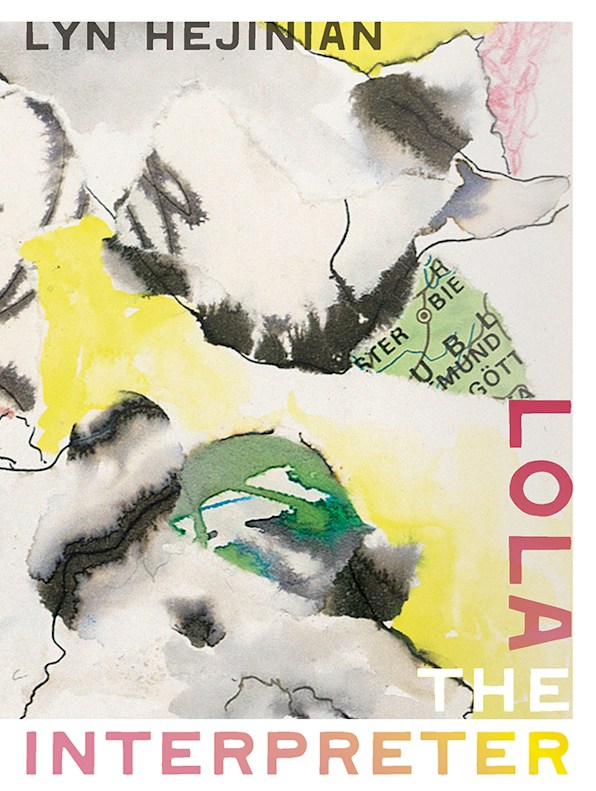
Reviewed by Rachael Guynn Wilson in Tripwire 23
“the thousandth bold uncertainty”: Skeptical Poetics in Lyn Hejinian’s Lola the Interpreter
Lyn Hejinian’s last book, Lola the Interpreter (Wesleyan University Press, October 2025), might, in fact, be two books—spliced and interlaced like a lenticular double-image, or the one hidden in the other like an anamorphic painting. Turn the book slightly, or regard it askew, and you’ll encounter its other face: a book titled “Motley the Interpreter” (128).
In the frontal-view book, “Lola,” a character distinct from the book’s narrator, appears as the hero of an epic whose central dramatic conflict is a philosophical one—one that I am, admittedly, hard-pressed to summarize. I can say, for starters, that it involves the relations between feeling, things, appearances/phenomena, thinking, and reasoning. At stake are ideas about the self/identity, freedom, and history. And coming under particular scrutiny is language: as a medium of sensation, interpretation, representation, desire, and reason. While Lola remains something of a pragmatist amid all this philosophical inquiry (she is a “junior analytic cartographer,” after all, and can’t afford to get lost in the metaphysical weeds), the sign under which this book unfolds is that of philosophical skepticism “[P]oetry is the skeptic’s philosophy,” writes Hejinian, riffing on Montaigne (9).
Now, the book read slantways gives us “Motley,” the comedic hero made up of all and sundry, sitting on a midden1 and sorting the heterogeneous miscellany of “everyday life”—like Winnie going through the contents of her purse in Samuel Beckett’s Happy Days. There’s a “can opener; Knudsen’s non-fat cottage cheese; Paper Mate Sharpwriter #2 pencil; size 7½ Baflinger Reine Schurwolle slippers; emery board; packet of 140 Post-it flags (languettes, banderitas)…”(89). Add to this “piles of citrus fruit, the oranges jubilant, the tangelos belligerent, the grapefruits paunchy,” “rivulets, back alleys, and storm drains,” and a cast of characters large enough to populate a small city—some living, some historical, some wholly invented (85, 9). One of the latter, a “Tom Victor Kraft,” we find frequently spouting lines of pure poetry: “Brotherfuck mothermouth turd-on-a-rock-in-your-face” and “pissing thug fuckers, slime baby birth idiots, NOW you see me!” (43, 101). His outbursts weirdly resonate with others delivered in what might be the voice of the narrator or the text itself: “Thistle down loosens lock time while profligate hens drag duck straw” and “slippage slat bough in metal drift if” (11, 42).
In Motley’s populous interpretive field,2 we experience the “raptures of proximity”: the roar of a “wood chipper hitched to the back of the city’s white pickup truck,” a procession of “parading pedestrians, miniaturized canines, and mumbling trees,” the “controlled abundance” of the supermarket, and an ever-recurring cat (45, 35, 103, 84). There’s the “lucent goo” of a single paint molecule, and sunlight, which, like language, operates as “an aid to appearance (102, 97). Here, too, is “the small hole that a thumbtack makes in a wall,” which “comes to exemplify daily life” (18). The text envelops us in such free-floating perceptions, whose catalysts seem to perforate language as a medium of representation. In the collages embellishing the section title pages, we make out textual fragments and torn bits of maps, embedded in watery abstractions. An allegory, perhaps, for the way language catches “bits of phenomena” in its expansive, hazy medium? Or, is it rather the way language isolates and delineates fragments of the world, focusing our attention on them?
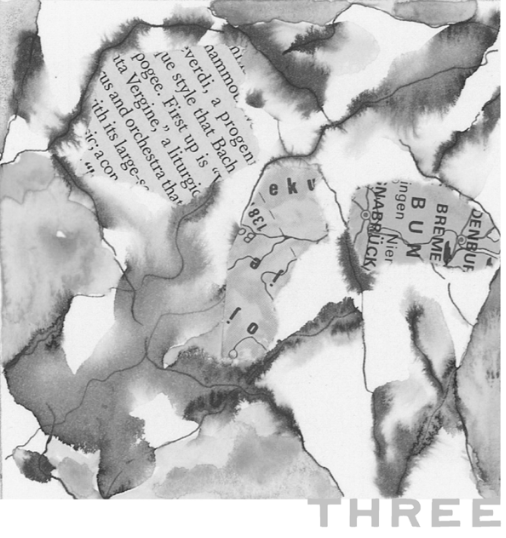
produced with permission of The Estate of Lyn Hejinian. (original in
color)
This back-and-forth, reversible figure/ground relationship between signs and referents, sensation and thinking, ideas and things, is the slippery terrain Lola navigates. “Before there’s a proposition there’s a judgment, before a judgment there’s an interpretation, and before an interpretation there’s a feeling,” Hejinian writes: “a parenthesis of feeling” (104, 105). Motley,3 one might say, is inside the parentheses, while Lola dips in but only to complete a PEMDAS operation.4 That, anyway, is what she tells herself: she acknowledges and makes use of her feelings but keeps them well-organized, in parenthesis, subordinated to and by reason.5
In truth, Lola is a barrel racer, and a brilliant one at that.6 “[B]arrel racing, that was a thing: dance around bellies at high speed. Lola got a feeling for the thing, I remember that: the course, the system, the pattern; at the moment of perception, there’s a flash of intuition, we could call it a first feeling (coming a split second after whatever our senses feel), and ideas and adjacent emotions follow” (113-14). The barrel racer rides her horse in a cloverleaf or trefoil pattern around three barrels in fixed positions. She rides as quickly as possible, hugging the barrels in tight turns without ever touching them, carving a figure around them, drawing a constellation through their plotted positions—giving them an interpretive, discursive shape.7 Lola, in other words, is wholly familiar with a horizontal (rather than hierarchical) mode of interpretation—that is, with the way “one thing interprets another; everything that happens is an interpretation, [and] each thing that exists interprets (105).8 A “Motley” style of interpretation, neither credulous nor skeptical but simply pragmatic. Like, “Tote sketch greets songy halt link bayside lilt wag weed” (143).
“Drawn by irrationality, held by reason, we are bits of phenomena, the substance of the phenomenal world,” Lyn Hejinian writes (115). As like attracts like, the mind gravitates toward matter; thinking is, in effect, matter’s interpretation of mind as much as the inverse. A thought is made by its objects, and thought itself is material, Hejinian also suggests. “The inexplicable as well as unextractable activity is thinking. And in the wake of thinking lie thoughts, impenetrable, mineral” (53). The phenomenal mind moves toward the phenom-enal world, and the structure of thinking, like that of interpretation, is essentially comedic: resulting in marriages, unions. Though often cast as analytic (dissecting), interpretation is, fundamentally, synthetic (compositing, composting). “Perhaps what’s principally at stake here is involvement—there’s always something optimistic sustaining it, something proper to comedy,” she adds (104).
Comedy is not the first thing that comes to mind when thinking of skepticism. The skeptic seems a dour and contrary type, only inadvertently comedic as, for example, when stuck in a bog.9 Skepticism appears to entail aloofness, to be above worldliness. As if considering this impression, the narrator of Lola remarks, “skepticism is seldom directed at housework, housework requires either resignation or willingness as one sets oneself to washing dishes, vacuuming floors, sorting socks, making beds…” (103). Even so, in the variety of skepticism that emerges in Lola, the skeptic is decidedly engaged in everyday life and directs her skepticism all over. Skepticism is a manner of interpretation, and so it involves involvement, requires participation; the skeptic is tethered to the world by “a participatory distance” (144).
As a non-philosopher, I try to grasp the crux of skepticism by conceptualizing its opposite—which, I venture, is belief. Some qualities of belief that come to mind include: steadfastness, invariance, immovability, immutability, totality. By contrast, skepticism could be characterized by mutability: The skeptic doesn’t hold fast; a restless thinker, her uncertainty keeps her rolling along. She is ever doubting, probing, revisioning, going over things already declared set-tled—two, three, an infinite number of times. “The skeptic makes a return,” Hejinian writes in the book’s closing line (144).10
It’s a strange thing, I’ve thought, that Lyn Hejinian should have written a treatise on skepticism in the form of a prose poem with characters. Hejinian was a brilliant critical writer, as works like The Language of Inquiry (UC Berkeley, 2000), or her recent Allegorical Moments: Call to the Everyday (Wesleyan UP, 2023)—both of which have many threads entangled with this book—amply demonstrate. Lola, however, no matter how much it pushes at the limits of genre, remains poetry, which, we might recall, “is the skeptic’s philosophy. Systematic or not, the philosophical treatise gets awfully close to doctrine, and therefore to belief or conviction. “The trouble with elevating the power of reason to a preeminent position and giving it ultimate authority is that it is always someone’s reason,” Lola’s narrator reasons (93). A poem, on the other hand, “commits linguistic acts of aggression, its line breaks short-circuiting certainty” (34). “Blunder watch do is for closely language on” (52).
Language is a strange device. Does it watch, does it do? It certainly blunders. It blunders in its watching and doing “closely,” its being “on,” and the blundering is even a kind of pleasure, provoking renewed attention and engagement with things and ideas—more blunder-watching and blunder-doing. In her poetic attention, as in her skeptical regard for all she encounters, the poet-skeptic becomes more, not less, involved with the stuff of everyday life. The poet asserts, “It is precisely so as to embrace the radical particular in its gritty quiddity… that I began and will continue” (71).
In response to which, the skeptic counters, “[Yet] the gap between words and worlds reveals meaning’s abyss, the impossibility not only of objectivity but of objects” (55).
Then, the poet-skeptic shouts, “But concepts aren’t mere distractions; the matter versus metaphysics dispute is as inane as the form versus content distinction. Behold the thousandth bold uncertainty: a marigold! Or maybe a zinnia?” (96).
Or perhaps it’s a dahlia after all. Either way, the poet-skeptic makes a return, elaborating her engagements, slowing down sense judgments, allowing for complexity, and developing her capacity for nuanced feeling, perception, and reasoning. Lola the Interpreter could teach us something about the rewards of a skeptical poetics. But don’t take my word for it. A true skeptic should investigate for herself.
Lola the Interpreter is published by Wesleyan University Press
1 “Lola would object that the things that surge past or tumble by are just quickly and peremptorily thought-out whims, to which I’d retort: they are flapping from files and will pile into middens with architectural as well as columnar effect” (9).
2 “The site of interpretation is not a ruin but a dump” (23).
3 To the extent that there is such a character, since, in fact, she’s only a fleeting, farcical suggestion.
4 Parentheses, exponents, multiplication & division, addition & subtraction.
5 “Consciousness, even if only as a sorting of sensations, exists prior to reason, but without reason consciousness would be immobilized, static, incapacitated”: this could be Lola speaking (86).
6 Lola is “a dauntless barrel racer” (9).
7 Technical information on barrel racing comes from: “Barrel Racing,” The National Cowboy & Western Heritage Museum, https:// nationalcowboymuseum.org/explore/barrel-racing/ and “Barrel racing,” Wikipedia, https://en.wikipedia.org/wiki/Barrel_racing.
8 Earlier, Hejinian writes, “Everything that exists is involved in perpetual processes of interpretation, simultaneously generating causes and effects” (16). I suspect that what Hejinian’s driving at is the idea that there’s no independent existence or appearance. Everything is mutually constituted as subject and object, interpreter and interpreted, and thus, that the phenomenal world—the world of appearing and sensing—is necessarily social and inherently political. Her collaborative books with Leslie Scalapino, Sight (Edge Books, 1999) and Hearing (Litmus Press, 2021), explore this premise.
9 See David Hume.
10 Hejinian made a poetic practice of returning, as in her major work, My Life, a prose poem with 37 sections of 37 sentences each, written when the author was 37 years old and published by Burning Deck in 1980—to which she added 8 new sections of 45 sentences each, as well as 8 sentences to the original 37 sections, to make a second edition written at the age of forty-five (published by Sun & Moon in 1987). In My Life in the Nineties (Shark Books, 2003), Hejinian returns to the project once again, writing another ten sections of 60 sentences each.
 Tripwire