
Reviewed by Annie Raab in Tripwire 23
What Writhes Beneath: Identity, Sex, God, and the Tranny Muse Above
There are some poets who are able to stratify the world into sections of perception, or to segment their own perception into singular speakers from whom their poems emerge. Versatile poets are able to switch between propulsive prose and densely symbolic linework, the type of which can sometimes read as personal and referential self-soothing. Poets are slippery, though. That old cardboard figure they evoke—the speaker—can take most of the heat readers and critics generate on their way to discernment. Ah, but we love the challenge. Give us fiction-bound readers something to gnaw on, a puzzle to unscramble in the reading experience. Ask yourself this: What freedom does a critic allow a speaker if they are a hyper-real facsimile of the poet? What about when the speaker is a tri-faceted creation, with one third in the peopled world and one third in the dimension of poetic theory?
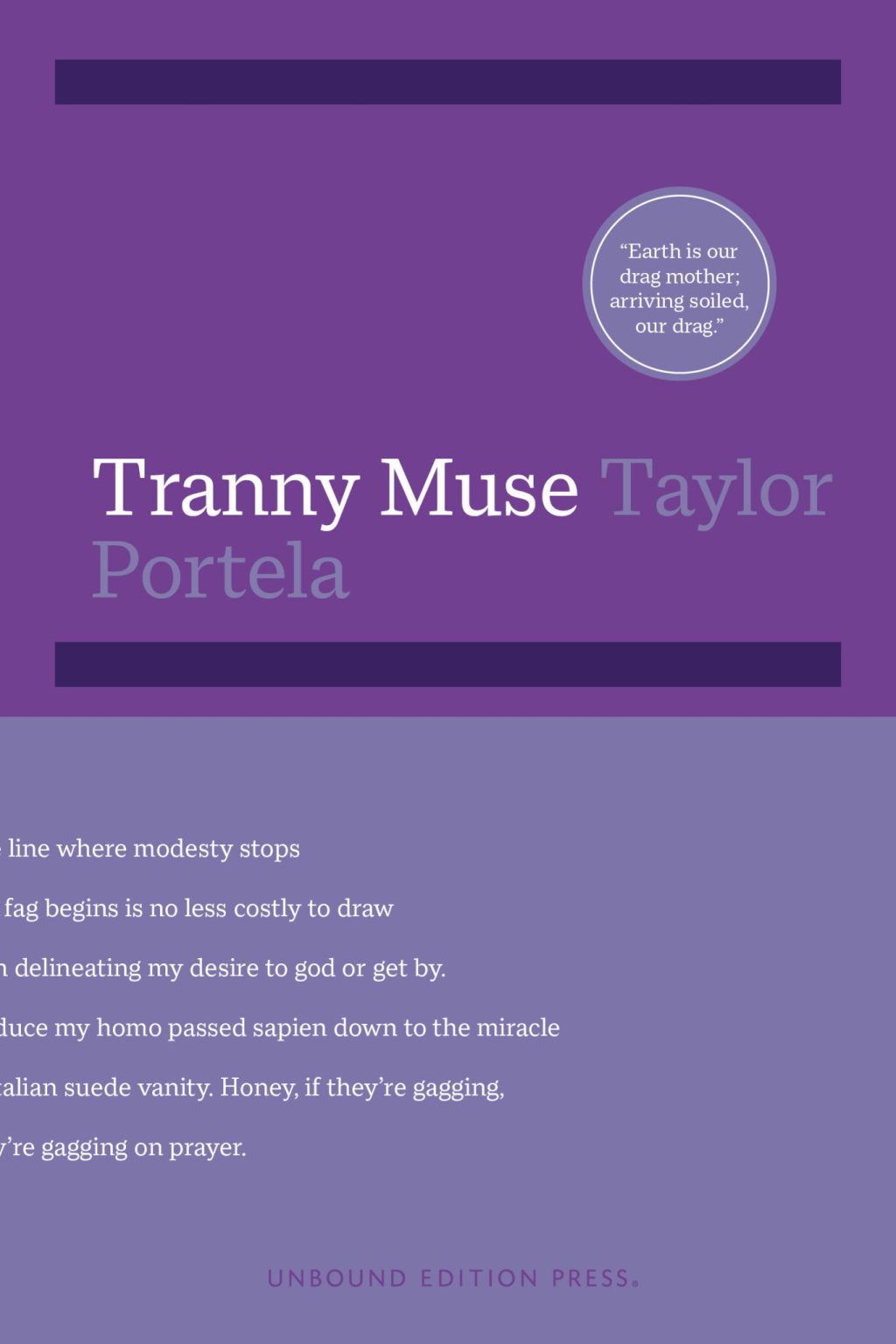
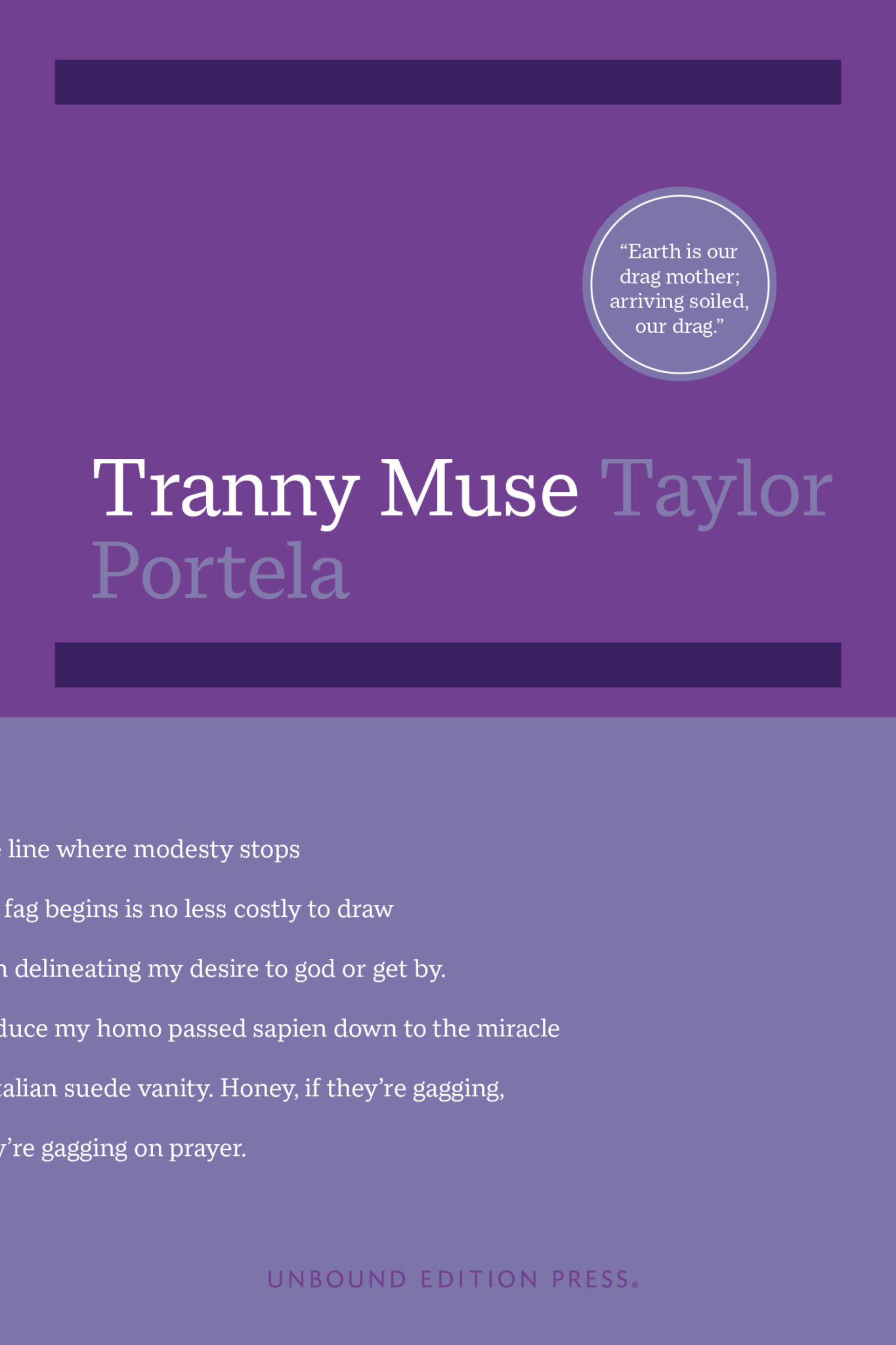
These are questions that arose while reading Taylor Portela’s debut collection, Tranny Muse. Divided into the Books of Taylor, Lavender, and Portela, the poems embody three speakers. In the Book of Taylor, the speaker spends time converting their childhood experiences into poems that foreshadow a later lifestyle. For instance, in “but for how long?” a young Taylor equates the bees his father exterminates from the window to a community, with hierarchies and dangers and joy:
i count golden bodies and name each friend
boyfriend as i sticky with fever and fall asleep
in daylight the bees turn me to preythey stand me up straight like the only son
reprimanded for endangering the brood
through thorax dreams turned absand pollen well you know
i make promises to the insects
whisper all the ways i’ll procreateto fool them into thinking they built zion (34)
How satisfying it is to see a poet work the hallucinatory experience of observing a steaming, pulsating hive into a foreshadow of future bodies moving as one. The Book of Taylor goes out to anyone who has ever tried to pause the ceaseless existential questioning that whirrs like a hive in the mind with all-out abandonment on the dance floor.
Lavender addresses the Tranny Muse like one might pray to God in spare and private moments. Portela, the final facet that narrates the Book of Portela, is the latest in a lineage Portelas. They are historical and grounded, composed of family recollections from the past that reconvene reincarnated in the present body—an Orlando in headphones and crop tops, doing bumps of K and thinking in tercets. These Books are anchored by Alex Baird, the author’s great-great-great grandfather, who immigrated to America from Scotland in the 1930s and whose autobiography serves a different purpose for each member of the speaker’s family, and whose own words appear interwoven through the narrative:
Alex’s first memory is one of violence. To make a good boy out of him, his father whipped him. By eight, his bachelor boss delighted in his abuse. He learned that God reserved hell for bad boys, so rejected this two-faced God in favor of a sailor who returned home with nice clothes. A blue jacket and white pants convinced him to become one, or die trying. When he returned home from his first trip as a cook, his mom admitted that she thought he had gone up in smoke. (26)
The Book of Portela examines the persecution the early Mormons in the family faced while reaching coming-of-age milestones that fall far outside the faith, represented by torn up photos of Shakira and doing yoga while Will and Grace plays on TV. Even when tenderness arises in the family history, the speaker refrains from tipping over into sentimental terrain. Portela (the poet) keeps the language of nostalgia on a short leash and fur collar. Each Book is ordered carefully, so that the themes and structures seep between contaminants into another body altogether—a lovely strain of listeria linking Taylor, Lavender and Portela to one another. Impurity spreads throughout the text more quickly and as undetected as transgressions at Bible camp. But religion in Tranny Muse is not discarded as another oppressive force against gender, sex, or identity. Portela takes a theological approach to faith, drawing from their own Mormon background and defining the lusty search for God as a source of ever-replenishing nectar. As soon as the speaker tries to identify, wearing and acting out all the correct signifiers, another tectonic layer of identity slips from its place and rearranges the image, as it does here in “Gucci for Jesus”:
No matter how I work my double-g’s I’m read
as starched shirt and khakis passing the sacrament.
My delivery doesn’t matter. The line where modesty stops
and fag begins is no less costly to draw
than delineating my desire to god or get by. (36)
“To god or get by.” “Drunkfagged.” “Grow me in the cum of the sea.” There are risky pairings like this throughout the collection that slip, linked, into enjambments. The poet has always been more suggestive than the theologian and the philosopher. It is their job to be hospitable to fragmented and provocative turns of phrase. Portela performs a nifty sleight of hand in such poems, connecting the eternal quest for God to drag and piss play:
Call me compost, sinkhole! Where I testify
lightning cracks against my spotlit bussy
illuminating my quest to trash dancefloorsbaptized by mommy and daddy complexes!
On stage, I’m a Joseph Smith complex
nightly anointing my angels flagging yellow. (83)
Hot stuff happens in the margins and between the lines, like a great night in a new city. Therein lie the kinks and cocks and MDMA and all-night pagan parties. Do not despair: there is actual sex in Tranny Muse, too, the text swirling around rims both porcelain and puckered to evoke an anti-repressed anthem for the flesh. Don’t expect to read this with your hand down your pants, however. But do expect to lift inspiration, line after line, to sext your daddy sir residing in the rowhouses of Cap Hill:
I blare house music so my intestines know what to mimic.
Not silent anticipation, but a steady, definite progress.
Leaving the toilet for my hands and knees to pop in
another douche, I about soil the room with my bulk when
the trick saunters in with the warbling synth, cocky like
he’s the only dom in the world. (53)
Language shimmers when poetry meets sex. This is an incontrovertible truth among the literary and the horny—a Venn diagram that is dwindling, in our neo-puritan age, to a sliver. It explodes again in Tranny Muse in surprising and imaginative interplay. Thank God. Even if (maybe especially if) that God in the text is a polygamist. Evaluated on linguistic agility and on the many switchback transitions between inquiry and masturbation, Portela’s nearest literary relative may be William Gass. But instead of blue, it’s lavender.
At the end of the collection, it is tempting to summarize the multiple facets presented in the Books based on the final piece alone. Try not to. Portela does not carry words around in a suitcase, assembling “what happened” into neat narrations. Although some of the poems brush up against what I dare to call biographical prose, the language romps on such a multi-dimensional playground that it is not meant for the reader to grasp at personal references. As names are hidden beyond the first letter of each name, the poet too is hidden behind every letter in the collection. What we know about the writer from their biography and acknowledgements is eventually overshadowed by the philosophical thesis of the collection: identity—the concept and the daily practice—is a trap and a limitation. Indeed, if the tranny muse above us all is listening, I hope they hear the exaltation in this text that comprises the center of these poems and bestow upon us readers an extended pause on our gag reflex.
Tranny Muse is published by Unbound Edition Press
 Tripwire