

Reviewed by Sarah Burgoyne
Prose Enjambments: The Heart Opens Fire
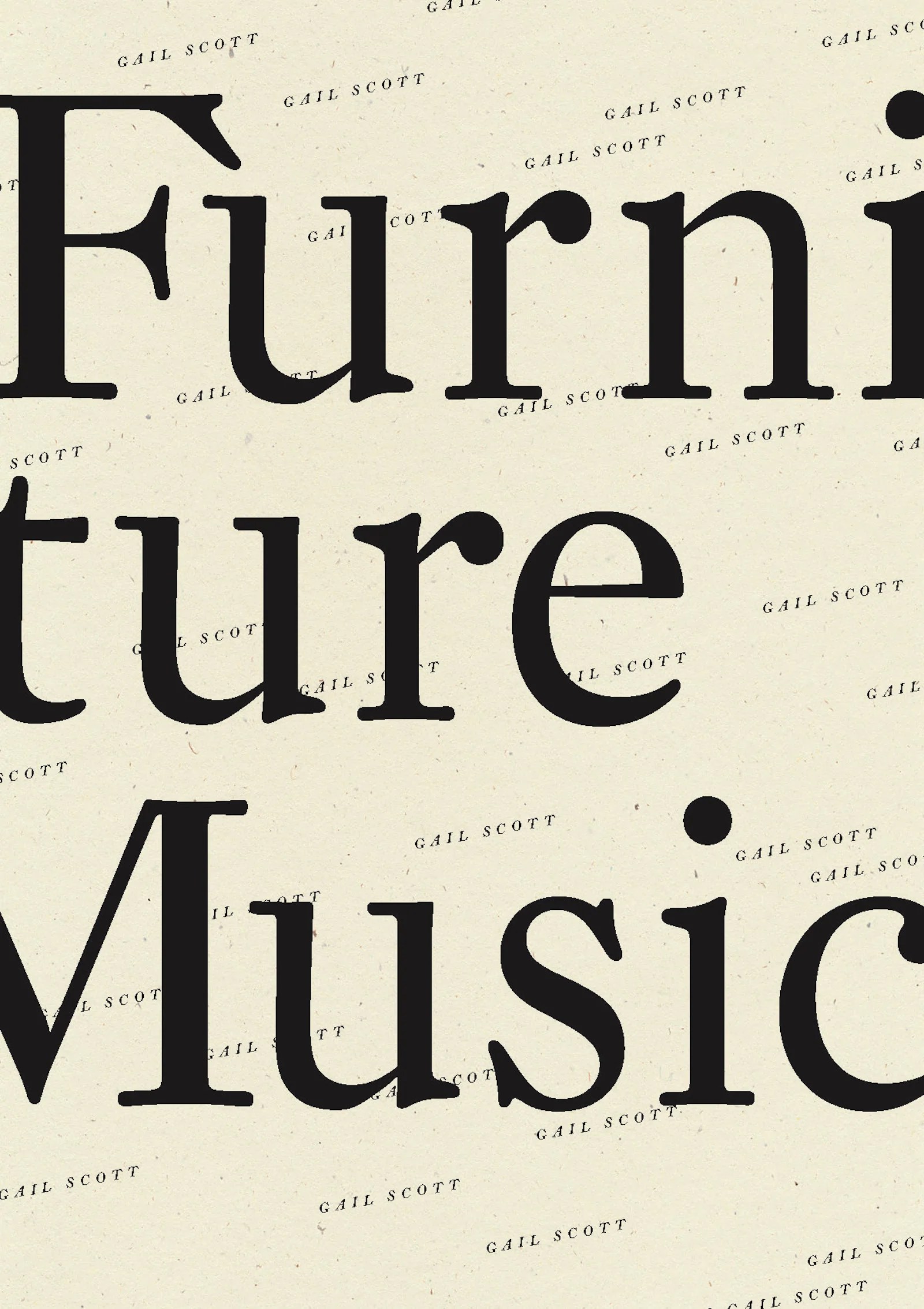
If a poem is simply (or complexly) “something made,” as its Latin root signifies, requiring attention in the process of its making and demanding attention once made, then poetry abounds in the spaces surrounding the quoted poems in Furniture Music. Gail Scott’s memoir, organized by musical notations and punctuated by excerpts of poetry by New York’s remaining avant-garde, thus harbours many poems. The loudest “poem,” perhaps, is the snowshoed walk to Parliament of a group of “youthful First Nations” from James Bay: “In up to -40C weather. Joined by hundreds more. Bearing gift for Conservative Canadian Prime Minister. Pair of beautifully crafted snowshoes. But where is Mr. Harper on day they arriving in Ottawa capital? In another city welcoming pair of pandas. Flown in from China. They’re very wriggly, he giggles.” This “ostinato refrain,” as Scott frames it, which means “recurring frequently” and also “stubborn and persistent,” bears the shape and flow of poetry. What do I mean by this? A poem is often an act, a gesture, a demand for attention, an insistence, the flow of fabric as a body flails, dances, marches, strikes out (in protests or long walks) beneath it. People in
Manhattan dancing or singing after the election of the first Black president is poetry. Likewise, fashion, famously ambiguous, is Furniture Music’s tonal punctum: Scott notes the post-2008 crash epoch is characterized by a narrow, dark silhouette, “cheap saddle shoes,” Michelle Obama’s metonymic arms, with the narrator (our “Northern”) reminding us that fashion is also something that, like poetry, can express resistance.
Furniture Music is a memoir that takes poetry’s roominess, its “space for affect and excess,” as Scott puts it, and injects it into the veins of prose. Scott’s chronicle of her Manhattan residencies spans eight years, taking the city’s pulse during Obama’s 2008 election and re-election in 2012 and the financial crash (spelled “Krasch” in FM), during which she mingles with the city’s leftist poets and writers, in some cases deepening significant friendships (another type of poetry). In a recent interview published in The Believer, Scott states “All of my novels are written in a social context that bears discussing. Every period requires a different kind of experimentation.” Furniture Music departs from its progenitors (her recent book of essays Permanent Revolution and her novels such as The Obituary, Main Brides, My Paris and Heroine) in its overt dialogue with contemporary poetry by leftist experimental poets who make up the St. Mark’s Poetry Project, Belladonna Collaborative, and Bowery Poetry Club scenes (Eileen Myles, Leslie Scalapino, John Keene, Anne Waldman, Charles Bernstein, erika kaufman, Camille Roy, Stacy Szymaszek, Renee Gladman, Carla Harryman and most prominently Rachel Levitsky, to name a few). Furniture Music dislocates our thinking around the relationship between art-making and politics and returns us to the
question: what is urgent?—or perhaps a better way of phrasing this would be what possibly, today, could not be?
The memoir eventually heralds Trump’s impending and much- dreaded election. It is also, therefore, an indagation of the questions “what does poetry do?” and “what can narrative do?” in the face of political bedlam. In exploring the dialectical relationship between art-making and resistance, the reader is left to wonder how much imagination revolution requires and if the way we use language (whether poetry or prose) bolsters our ability to imagine it? Furniture Music starts with the primacy of language in shaping occurrence and ends with poetry’s ability to create space, or, as Scott puts it: “for freely imagining. Edges. Of le possible.”
For example, the narrator asks, in the constellatory logic of “wide empire thinking,” what impact do poets have? The question is posed as the narrator frequents St. Mark’s Poetry Project, founded in the politically turbulent 1960s, which hosts poets like Anne Waldman (who once said her life’s work is to keep the world safe for poetry). Poems are integrated into the memoir, cited in the margins like Maggie Nelson’s work of autotheory, The Argonauts. Like Juliana Spahr, who sees resistance poems as the dogs that bark alongside a protest, the poems Scott cites contribute to the thinking of the work; they converse, punctuate and synthesize, like haiku at the end of haibun(-on-fire). In other words, prose and poetry work interdependently here. Urgency among the writers Scott includes is felt and practiced collectively; they are not a chorus but an emanation. For example, Scott reprints the opening stanza of Waldman’s 1989 poem “Revolution” after exploring the
discourse around American “culture wars,” concluding that the “politics of Empire chip away”:
Spooky summer on the horizon I’m gazing at from my window into the streets
That’s where it’s going to be where everyone is walking around, looking around out in the open suspecting each other’s heart to open fire
all over the streets
This memoir queers the memoir arc. It falls within the paradigm of Hejinian’s My Life—an autobiography written in Theory-A- Sunday’s coined term: écriture au feminin. But Scott’s work is much more deeply (or overtly) concerned with expressing current social issues. Like Hejinian’s lines, Scott’s have “vertical intensity,” a term Hejinian coined, comparable to Benjamin’s jetztzeit (time that is ripe with revolutionary possibility) or “the single moment into which the idea rushes.” The relation of Furniture Music to the now is figural, in the same way the memoir’s cities (Montreal, Manhattan), political leaders (Obama and Mr. SHHH) and writers, (our “Northern” and her friends, the “USian” poets) form a constellation which presents to us, like Klee’s Angel (what Benjamin called “The Angel of History”), a chain of events: “one single catastrophe which keeps piling wreckage upon wreckage.”
In Furniture Music, the sentence is something which “tilts toward the preconfigured/habitual,” whereas poetry houses “slants, estrangements, apostrophes” and addresses “the unreliability of predicates to do with time.” Even “if not poet,” Scott offers “in
[her] narratives, sentence relations. Close to poetic enjambment.” This is not a hybrid work but rather a tentacular work, feeling toward its time. In an interview from the late nineties, Scott expressed that writing is “about affect as a screen for all the social and political and cultural and personal and geographical particles, captured somehow in syntax, which is music. All the things that give tone to a moment in time. This surface is always in flux.” It’s this in-fluxness, this “vexed resistance to a regulation that [she] must honor […] to prove how beautifully one can improvise against a basic structure,” as Fred Moten described Mingus, that is the ongoing trademark of Scott’s brilliant thinking and writing. I return to Scott’s works again and again as a reminder that there is a necessary and ongoing relationship between art and politics and that the way we use language can work equally as hard to perpetuate or disrupt systems. We need more sentences, like Scott’s, that look ahead instead of back, that tip us forward into vigilance, music, and flux.
Sarah Burgoyne lives and writes in Montreal/Tiohtià:ke, Canada. Her most recent book, Mechanophilia, is an infinite collaboration with American writer Vi Khi Nao based on the number pi.
Furniture Music is published by Wave Books
 Tripwire
Leave a comment