

by PJ Lombardo
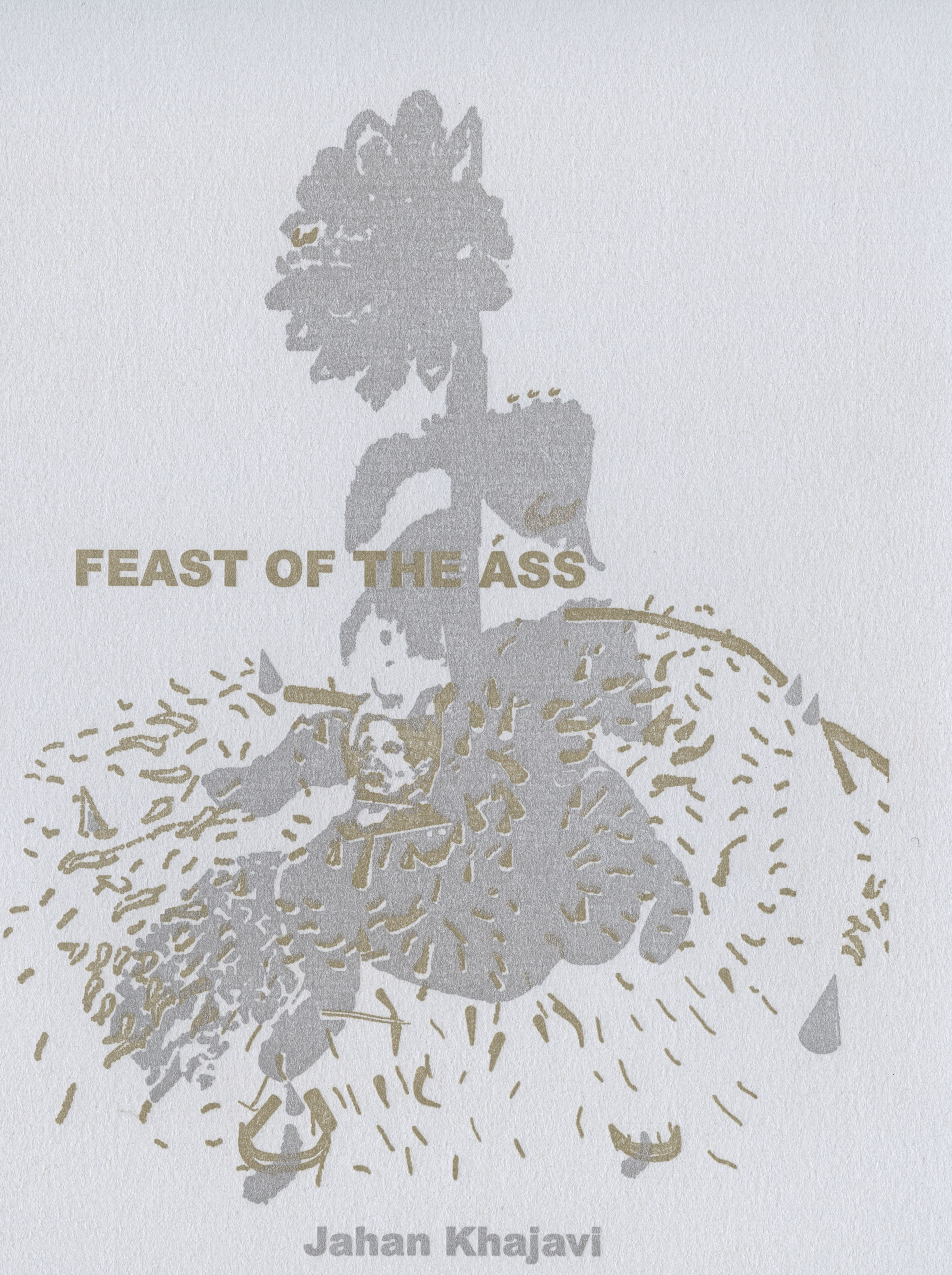
For over 20 years, Ugly Duckling Presse has published some of the most thrilling, challenging literature available. From Maria Negroni to Tomaz Salamun, the publisher’s range is singular. Ugly Duckling’s international emphasis, along with their enthusiasm for emerging poets, is key to this dynamism, as the press continues to publish refreshing deviations from hegemonic American discourse. Jahan Khajavi’s debut poetry collection, Feast of the Ass, is another stride in this direction.
Two quatrains at a time, Khajavi’s text reposes in vitality. “Though not composed expressly for your entertainment, / come lounge here all those longing to enjoy these poems.” The Ass is not a prescriptive, spartan work, and it doesn’t crutch itself on pyrotechnics. Instead, the Feast performs generosity with glittering, historically-informed technique.
A refreshing departure! In our time, artists lapse too frequently into binarism: either self-serious priesthood or conveniently vague positioning. Obviously, these are both defenses against the idea of “art-life” as frivolity or relic. But poetry requires a determination that might be possible only through shamelessness. Feast of the Ass proffers something more and something less: “nothing but a growth…a loafsome progeny to live beyond our years.” Only a growth, but a growth is so much, dependent on the type of kinetic precision found in Khajavi’s prosody.
Evidence of this is the book’s use of rhythm, allusion, consonance, and dexterous syntax. In particular, Khajavi’s allusions deliberately draw readers to the lineage in which this text participates: “By way of an informal formal introduction / to this epic rubaiyat—our latent style / leanings begot this cross-breed by-blow reproduction / of Uncle Omar & Orlando.” The conjunction of technique with exhortative indulgence is antithetical to Western contemporary burnout, which abandons its subjects to loneliness and paranoia. In order to re-enchant life, existence must be exalted fully, with unguarded tenacity. Poetry of this kind luxuriates in the labor of the real.
In the Feast, celebration and labor are not irreconcilable—in fact, they demand each other. Khajavi’s work is something like a sacrificial saturnalia- though all too often “it pays / us nothing,” the challenge itself is worthwhile, as “much of what our rotten mood & vicious attitude / can do is discern for us the difference of this habit / from a hobby…” Feast of the Ass delights at the chance to resolve these oppositions, to connect work with leisure, bliss with suffering, grief with togetherness.
Repetition and rhyme in Feast of the Ass harmonize throughout, typically in double-quatrain form featuring prominent repetition, especially at the ends of lines. Khajavi presents this design in his introduction, alongside a few motifs. He describes the “window of an empty unisex salon/in Long Beach, California with these words upon/the unwashed glass, the services that one could get,/we guess, in off-white vinyl letters: Beauty/Fades.” Khajavi regiments a boisterous pace alongside his formal coordinates. Rhymes are legible but understated. Concepts explicate themselves enough for comprehension without a forfeiture of agility. Then, on the next page, when Khajavi expresses a contradictory desire (for “a commonplace, a refuge,” for “our labor” to be found timeless in the future), the transition is seamless. The Feast of the Ass darts from one concept to its opposite with a pop-star’s slickness. Dissonance through consonance and vice versa—a dialectical feast, satisfaction and longing at once.
Khajavi’s craft is fundamentally sincere, insofar as Feast refuses to gawk at its own irreverence. Sadean “experimentalists” too often take oppositional defiance to be itself a virtue, but this Feast writes delinquency as a happy accident. Khajavi’s promiscuous experiment is indifferent to this demand. The Ass is tenacious enough to revel along discipline’s edge, to take constraint as catalytic. “Dear prison-guards, give our regards to that warden-angel who awarded/us this writer’s residence…Treat us how you please, however poorly…as long as with our fellow fellows we are both bedded & boarded—// preferably in pairs as research towards our own De Profundis” (49). An acceptance too ecstatic for any corps to suppress. Feast of the Ass writes with the only real bravery around—the bravery to withstand cruelty without falling into compromise, cowardice or rationalization.
Khajavi’s speaker is a “we,” a kinship, a plethora, abundantly garlanded and unafraid of its own damage: “While others try to keep unspoiled their fingers & their lungs/we joyfully instead let tea & cigarettes spot ours./While others looking for themselves alone go into caves…we gaily stay where we’re aware of where we are—among/the others in this bar, all well aware the World’s not ours.” Ethics requires generosity, and here generosity is nothing other than the ability to rest inside the world as it is. There is no ethics without community, and Khajavi’s speaker identifies accordingly. The Feast runs contrary to an “exemplary” mode, whereby artists struggle to model ideal behavior, and readers struggle to validate their own perspective through its reflection. Instead, this speaker aspires to a communion unbuffered by insecurity. The Feast of the Ass exhorts vulnerability, a laughing truth, irrepressible through grief or mortality or any living misfortune.
Humor, in Feast of the Ass, is not snide, self-gratifying, or fickle-footed misdirection. Quite the opposite: “Since language is a virus/& we wrote this after swallowing their cum/we must we must we must cite this poem as theirs.” Khajavi’s sense of humor isn’t the typical internet-bogged satire in which contemporary culture is curdled. Rather, these poems let readers laugh at their tenderest points with all the bravery requisite for collective catharsis. Sensitivity is promoted, rather than shielded, through bacchanalia. A Feast to be shared, a makeshift communion. The humor of the Feast explodes with intimacy, an intimacy of endless assurance, a desire relentless enough to stomach filth and opulence alike, which is how it must be, since both are one loving-labor, and since “we know of only one thing that can quench/a thirst as glamorous on nights as this/& our beloved has a zipper full!”
PJ Lombardo is a writer born in New Jersey. He earned his MFA from the University of Notre Dame while working as a publishing assistant for Action Books. Currently, he lives in Baltimore, Maryland, where he co-edits GROTTO, a journal of grotesque-surrealist poetry. His work can be read in The Quarterless Review, KEITH LLC, Mercury Firs, SPECTRA Poets and elsewhere.
Feast of the Ass is published by Ugly Duckling Presse
 Tripwire