

reviewed by Matthew Rana in Tripwire 22
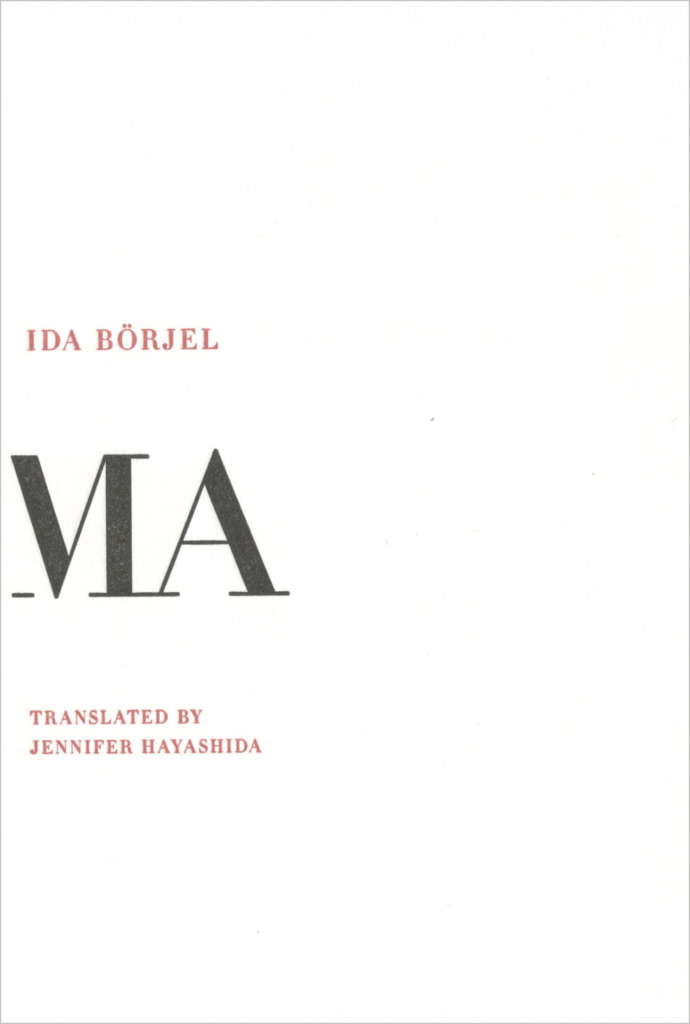
MA, by Swedish poet Ida Börjel, is a long abecedarian poem patterned after Inger Christensen’s Alphabet (1981). In twenty-nine sections going from A to Ö, the final letter of the Swedish alphabet, the book charts nothing less than a history of global catastrophe spanning the whole of “Gondwana / broken off from Pangaea,” as Börjel writes in the poem’s opening pages. This collection of often short and spare stanzas mixes fragmented impressions with facts, historical accounts, and items seemingly culled from social media and the news. Historical and contemporary events gradually become indistinct and begin to fold into one another in a continuous stream that at times recalls the experience of doomscrolling. Take, for example, this extract from section ‘C’:
demand for western jeans
in the DDR; wandering cells; current of goods
among party loyals
at the Friedrichstrasse metro station
current roving through crosscurrent; a
soccer team’s jersey ads
for the Libyan engineer’s green book
there was also; cybernetics
crack addict, cystic
Readers familiar with Börjel’s chapbook Miximum Ca’Canny The Sabotage Manuals: You Cutta Da Pay, We Cutta Da Shob (Commune Editions, 2014), also translated by Jen Hayashida, will likely find MA very different in style and tone—though both books were written at around the same time. Whereas the former draws primarily on historical materials to catalogue minor acts of tactical resistance to wage labour and exploitation, MA is by contrast a deeply personal inquiry that offers little in the way of practical advice.
MA was written while the author was mourning the loss of a child, a fact most palpable in sections ‘M’ and ‘X’, both of which shift to a lyrical mode (they are also left-aligned whereas the rest of the poem is right-aligned) as they struggle to put words to a grief that defies expression. These contain some of the book’s most harrowing lines, such as: “if death was a girl / I would bear her with care / she would be named.” Or elsewhere:
It should not be possible to write
how can I be where the poem is
death
death I want to be
if you are dead/there
sunhaze.
Here, language writhes to accommodate a loss so devastating that it requires new vocabularies, and Hayashida’s translation expertly renders into English the author’s terse and agonized Swedish.
Yet to only read MA as writing-through an experience of motherhood that was interrupted would be to overlook its profound political investments. Börjel’s brilliance here is to extend this sense of personal tragedy to the collective and, most importantly, back again. For as much as it is riven by uncertainty and a sense of poetry’s futility or impossibility, MA also attests to the poem’s social function as a site for not only the individual expression of grief, but also collective mourning and remembrance.
Rereading MA a decade after its original publication recalled for me the fraught affective space that started to emerge around 2014, in the wake of what many saw as the ‘failures’ of the Arab Spring and the Occupy movement to, if not establish something enduring, inaugurate a new period of anti-capitalist resistance. In Sweden, this period also corresponded with a crisis of the social-democratic state: in 2010, the far-right Sweden Democrats, now the country’s second-largest party, gained their first seat in parliament, in many ways foreshadowing the country’s current political climate, which since the 2022 general elections has been shaped by a government coalition of economically liberal and ultra-nationalist parties. It was around this time too that ideas surrounding poetry’s resistant capacities were being extolled by thinkers such Franco ‘Bifo’ Berardi, who viewed the lyric poem in particular as a means to counteract the linguistic and psychological ills of what Börjel here calls, “the order / of the semiosphere; unwording.” Again without a revolutionary movement to programmatically attach their work to, poets could finally get down to “the monotonous meat world” of “the being that states I.”
Börjel traces these developments—and the melancholy to which they gave rise (at least in me)—in each of the book’s sections. The poem makes reference throughout to sites such as Taksim and Tahrir squares and Frank Ogawa (or Oscar Grant) Plaza in Oakland, as well as lesser known ones such as Eiraeiro, a secret prison in Eritrea, and the Atacama desert in Chile, where “[…] mothers / bent, parched, day after day / in the sifting of the desert where plowed-down / bone shards; bone meal.” Elsewhere, in a deeply uncanny moment, the poem makes reference to the Qalandia checkpoint in Jerusalem and the now-destroyed Jabaliya camp in Gaza.
This terrible return in the real bespeaks the timeliness of MA’s appearance in English translation. Indeed, it is worth considering the demands that a book like this makes on us at present, a time even darker than the one that the poet maps here. Börjel has claimed that her poetry insists on a dialogue with the unbearable. Enjoining us to grieve every dead child as though they were our own, MA makes good on that claim.
Matthew Rana is the author of Ardour: Poems from the Daud (Nion Editions, 2022). His critical writing has appeared in the Los Angeles Review of Books, Jacket2, and The Poetry Project Newsletter, among others. He is currently a PhD candidate at the Amsterdam School for Cultural Analysis, University of Amsterdam, and lives and works in Stockholm.
MA is published by Ugly Duckling Presse
 Tripwire