
Reviewed by Hilary White
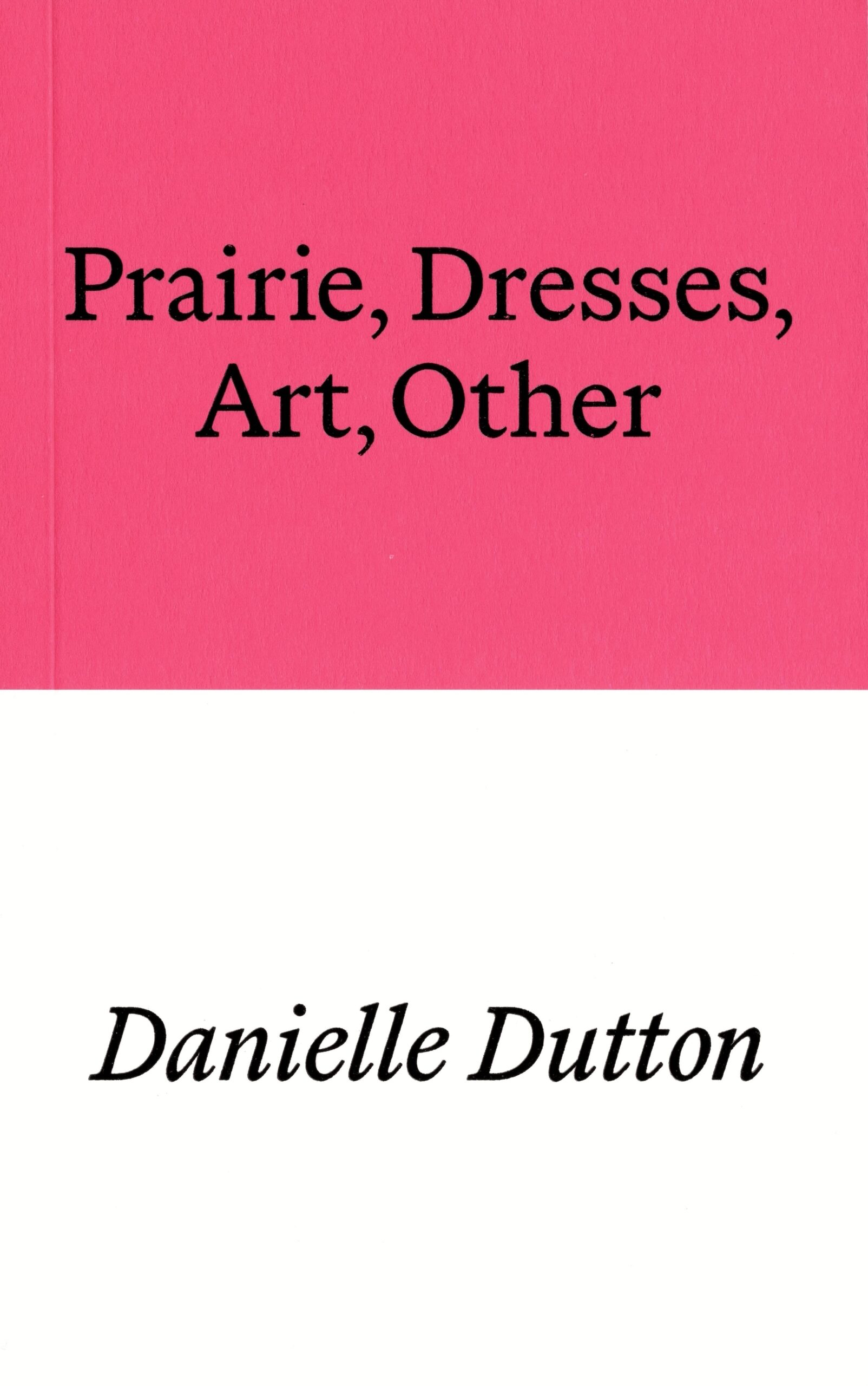
Prairie, Dresses, Art, Other is a varied collection of both fiction and nonfiction, including stories, essays and fragments, which refuses to coalesce into something ‘whole’, instead delighting in the interstitial possibilities of the incomplete. It is published by the innovative independent UK press, Prototype.
Previously Danielle Dutton has authored a biographical novel of the pioneering seventeenth-century philosopher, writer and scientist Margaret Cavendish, Margaret the First (Scribe, 2016), and experimental novel of the suburbs, SPRAWL (Wave Books, 2018). She is also the co-founder and editor of the feminist US-based press Dorothy, a publishing project, which has published two books a year since 2009, mostly by women, and whose list includes some of the most exciting contemporary writers as well as reissues of older innovators: Leonora Carrington and Barbara Comyns, along with new releases by Renee Gladman, Amina Cain, Cristina Rivera Garza and Nell Zink, to name a few.
The first section of Dutton’s collection, “Prairie,” is made up of five short stories, united by a consistency of theme (these include holes, absences, apocalypse) and narrative voices (generally frank, understated, observant), and by their attentiveness to the prairie landscape—especially its flowers. The second section, “Dresses,” is a constellation of decontextualised dresses from literature—a fractious tour both intimate and distancing: suggestions of the wearers’ stories emerge through descriptions of their clothing from shifting perspectives; the more shadowy suggestion of a potential larger arc hovers around the arrangement of the fragments. The third section, “Art,” consists of an essay titled “A Picture Held Us Captive,” about the relationship of writing to visual art and ekphrastic writing’s dual capacities both to hone the strangeness of art objects and perceptual experience, and at the same time their recognisability. The fourth section, “Other,” comprises short essays, prose fragments, stories and a play, the connections between these pieces more tenuous (and arguably less important) than in previous sections—the hybridity and resultant complexity increase towards the end of the collection. Various threads run through the four sections, especially aforementioned thoughts around ekphrasis and related concerns for translation, for what is carried in translation and where to, for the positionality of subjects in translation and ekphrasis. These threads subtly link the sections without presenting too coherent a casing for the book’s myriad, sometimes fleeting, sometimes lingering, concerns, for too much closure or resolution would feel wrong here.
The first story in the collection, “Nocturne,” introduces some of the subtly overarching concerns of the book, opening with a mother half-listening to her son explain death by black hole, while she drives through the West Virginia prairie at night, thinking of other things. She is already split. Catastrophic climate events intersect with the intimate, highlighted in this instance by the wandering thoughts of the narrator, which keep coming back to the present, the apocalyptic story her son is telling her, the moonlit sweet potato flowers. At the same time, a gigantic oil refinery visible in Kentucky threads with thoughts of an exhibition of cyanotypes of seaweed, prefiguring the multiple encounters with the visual arts that are one of the constancies in this hybrid and various collection.
The pieces in Prairie, Dresses, Art, Other are somewhat united by considerations of ekphrasis and translation—I say ‘somewhat’ because I don’t think uniting is the aim. The collection resists legibility and linearity in the conventional sense, more interested in subtle patterns and fractious resonances than coherence, in threads which disappear and resurface: like the wandering thoughts of the opening story’s protagonist; like the recurring gaps and holes which prevent linkage; like the attention to acts of translation, which might encompass acts of ekphrasis, both of which are somehow related to the category of the ‘feminine’—as Christine Brooke-Rose’s 1968 novel Between viewed the act of simultaneous translation, of conveying the words of others while trying to make oneself invisible, as a peculiarly ‘feminine experience’ (Stories 7). Another 1960s experimenter, Ann Quin, comes up in the collection, through discussion as well as quotation, and Dutton has written on Quin for And Other Stories, recent republishers of Quin’s fiction. Indeed, women writers in the 1960s shared many of the same interests as Dutton’s collection: in the fragmentary, unformed and incomplete. In different ways, Quin’s and Brooke-Rose’s fiction exposes its own architecture, not so interested in veneers of composure and completion, but in the undoing of forms and subjects. In Brooke-Rose’s work especially, the attempted elimination of the narrator results in a form of experimentation which is primarily observational and exploratory—descriptors I would also apply to Dutton’s shifting “I.” Translation and ekphrasis are processes which might transpose, describe, address a subject—acts of attention requiring if not suppression than at least the backgrounding of the ego. In its attentiveness to these processes over formal consistency and coherence of plot or theme, Dutton’s collection shows us what might happen in the minor spaces of the incomplete and unformed, where patterns and resonances are allowed to emerge, rather than being imposed on material which is then forced to fit a shape.
In “Nocturne” the quietly apocalyptic tone never leaves the story. From one hole to another, the final stretch lingers on a half-finished thought about climate change making holes in the permafrost in Siberia, in which ancient plants are discovered, a frozen lake. Someone climbs inside, but the woman’s thoughts move on, to the oil refinery she can see in front of her; the person is left perpetually hovering at the edge, their story or action never completed. In another story, the narrator recalls the artist Yayoi Kusama and her various acts of “self-obliteration.” Like the hypothetical molecular splitting of the body in “Nocturne” and the actual splitting of attention the mother invariably undergoes in that story, Dutton’s collection defies the unification of ‘self’—everything and everyone is split, hybrid, attentionally and even physically, in multiple forms at once. Notably, threats become more terrestrial and localised as the stories progress—from black holes and climate catastrophe, to reported assaults and the inevitable potential of pervasive male violence, in stories within stories, looming in the background of everything. The idea is always there, that something menacing could and will happen: “Bad things, I know, enormously bad, are happening all the time” (42).
In “A Picture Held Us Captive,” Dutton refers to “a politics of attention.” She is thinking of stories as spaces, but also of a story as embodying “a specific way of looking,” which is “a way of being” (75). Looking makes up so much of being, but there are ways too of reading looking which bypass some of language’s expositional awkwardness—and then there is looking as reading, and the ways in which vision and language are functionally inseparable (where does one delineate the visual from verbal in thought or in reading?). She starts to think of ekphrasis and translation as forms of collaboration. She imagines the story as “[a] hole we drop inside of” (95). A hole is a physical space which is also the physical absence of something—an absence which makes space. She says this again in “Not Writing,” while thinking of Renee Gladman’s statement that “[f]iction is a category of not knowing” (117), and then she falls asleep. Sleep has been described as “a perceptual hole in time” by the sleep scientist William C. Dement (Promise of Sleep 13). Holes which are everywhere, in life as in literature, are here both thematic connections and literal impasses to connection: gaps which prevent linkage, but themselves perform a repetitive pattern.
Figuring ekphrasis as a conversation as she does, it’s notable how many voices Dutton’s collection brings into the conversation—from the sixty-six quotations which make up the section “Dresses” to the presence of writers and artists throughout the fictional and nonfictional stretches of the book, which is always about reading and writing even when it is telling a story. Like many of the writers she converses with (Renee Gladman and Amina Cain, among others) she is not moving towards answers or resolution when she writes an essay or a story, but resting in the generative space of the question. This potentiality of the yet-to-be makes me think of what the theorist Erin Manning calls the “minor gesture,” which “alters to the core what thinking can do,” giving “‘value to the processual uncertainty of thought as yet unformed” (x); thought is by nature unfixed, in motion, gestural rather than fully formed—and this is a thinking collection. It also reminds me of Julietta Singh’s refiguring of academic work as a conversation, an exchange, rather than an aggressive procedure of identifying someone else’s lack and imposing yourself there—of “going into the holes.” In retaining the holes, Singh’s implicit advice, somehow the result is one of building rather than taking away—as conversation, another form of collaboration, builds.
The gaps between this collection’s various forms allow for so much to be said, linguistically or otherwise; the holes here imply not absence, but a refusal to be definitive, which would close down conversation.
Hilary White is a writer and researcher. She is the author of Holes, a novella published by Ma Bibliothèque in 2024. She is currently at Maynooth University in Ireland, working on a postdoctoral project called Forms of Sleep: Literary Experiments in Somnolence. Her writing appears in The Yellow Paper, MAP, Banshee, The Stinging Fly and others.
Prairie, Dresses, Art, Other is published by Prototype Press
 Tripwire