
Reviewed by Andy Spragg

Unsettled and unsettling
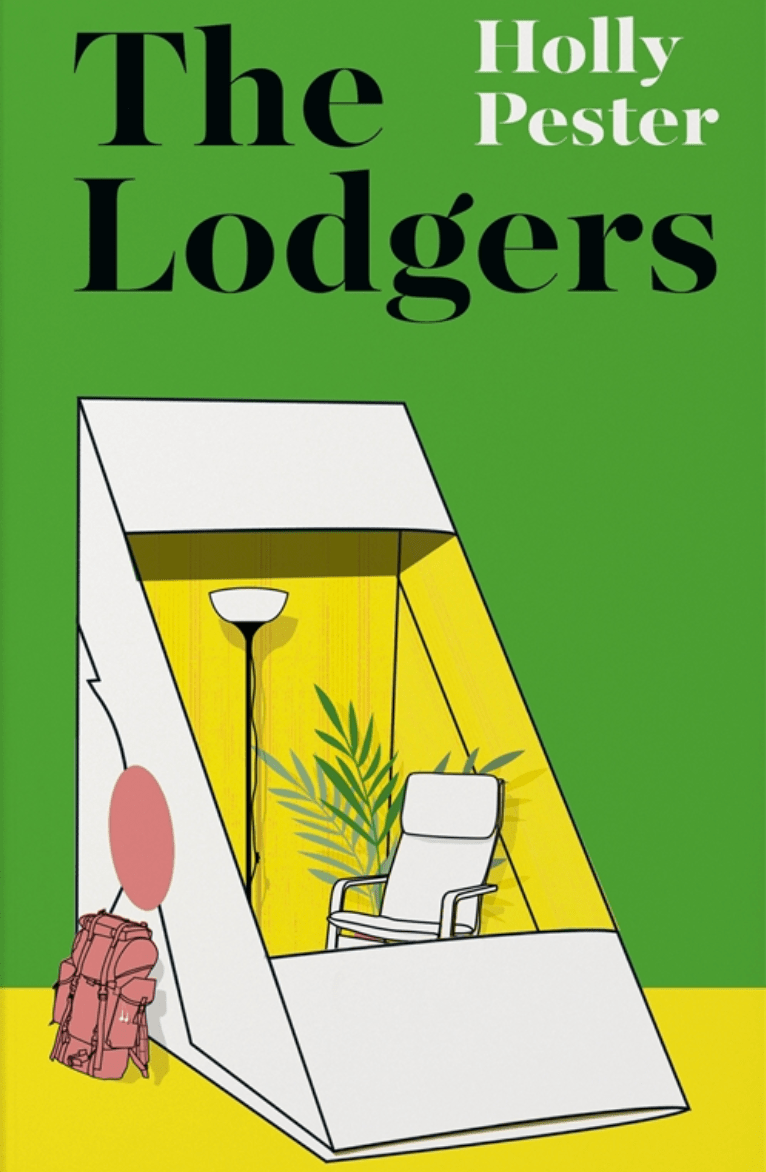
Holly Pester’s debut novel, The Lodgers, is an example of how her writing has inhabited multiple forms without losing its singular style and humor. In the past decade, Pester’s work has encompassed poetry (most recently Comic Timing, published by Granta), radio plays (Poetry for Idle Workers, broadcast on BBC Radio 4, and its script, Eclogues for Idle Workers, published by Distance No Object) and “10-inch vinyl album with an accompanying book of poems” (Common Rest, published by Test Centre). There is a restlessness in all this activity, though it is all thoroughly accomplished and consistently brilliant. Pester’s work is concerned with the business of how one lives, and how one does this in relation to the minutiae of commonplace objects and our social bonds.
Midway through The Lodgers, a single sentence encapsulates the novel: “Having to be impermanent but ready – like an imminent alarm clock, encountering street names and weather, sacrificing one plan and one direction in favor of another, regarding a nice tree, dead tree, common threat, bad design, couples walking
together, sunrise, nature in reality against my idea of it – is a socially inherited condition” (148). Being impermanent but ready is a neat summation of the novel’s premise: the narrator is a young academic who has taken a sublet room in a flat, one that is located not far from where her mother (referred to as Moffa) lives. The narrative shuttles between the first and second-person perspective. Chapters alternate between the narrator’s erratic orbit through her current living situation, and the life of a lodger that has taken on her previous living situation in another sublet room with another mother and her daughter (both unnamed). Both the narrator and the other woman take an unspecified university course, a mulch of holistic medicine and therapeutic practice. The narrator is in a precarious financial state. She has graduated, her next move is undetermined. In fact, everyone appears to be in one precarious state or another: the lodger is forced to fit around her landlady’s job providing beauty therapies to clients in her room during the day, itself a hallmark of the way that low-income self-employment can intrude on every aspect of the domestic setting (including the need to rent that space to a stranger in the first place). As the reader will have inferred, there are multiple parallels and contrasts in the set-up, and Pester’s accomplished style manages to interweave these into a compelling and sustained whole.
Pester’s writing recalls M John Harrison’s The Sunken Land Begins To Rise Again (Gollancz, 2020). It describes the same queasy and unexpressed tensions of sharing living space with relative strangers, and the way privacy becomes a guarded commodity; one constantly impinged by the scufflings and snufflings of people unseen but definitely nearby. Penelope Fitzgerald’s Offshore also
feels a likely influence, a novel about a group of relative strangers trying to mediate their common living situation. It is not just the setting that holds the three writers in common; Pester, Harrison and Fitzgerald are all accomplished stylists, who convey considerable depth of feeling with word-choice and sentence structure. The excerpt above demonstrates how Pester’s construction of the text can mirror the narrative’s constant deferrals and diversions, the way it snarls up and rucks its way to a conclusion.
The Lodgers has numerous rich linguistic moments. It is a novel full of words like “critterish”, “gargantuan” and “mayonnaised”, and also sentences like, “Together they are slurping and illuminated, living a quiet wholeness without you.” It is also a funny book: a group of children turn mobbish and chant NOT PRETTY at the lodger as indifferent mothers look on, an inexplicable character enters the narrative offering a deus ex machina resolution before promptly throwing up over the tools he is carrying. There is tension in these surreal vignettes, and Pester’s sharp navigation between the absurd and bleak undertows is one of the critical successes of the book.
There are also underlying themes of presence and absence in Pester’s book. Moffa is corporeally absent for a large part of the plot, though framed through frequent recollections. The sections about the narrator’s chaotic childhood are delicate and vital, and adept at describing the complex feelings that arise when a parental figure is unable or unwilling to occupy the role we desire or require from them. This is made all the more poignant by the moments between the other mother and her daughter, where the
other lodger observes their rhythms and routines from a distance, playing the role of imagined mother at times with a detached curiosity. Multiple relationships in the novel explore how we simultaneously reject parents while still wanting their love and acceptance. The Lodgers describes the heady mix of affection, anxiety and fear that comes with gluey familial bonds without making its characters into villains or becoming a morality tale about poor parenting. Moffa is seen as a point of refuge and return by the narrator, albeit an ambiguous one that is synonymous with a disproportionate sense of responsibility. The narrator is shown as both child and sometimes carer for Moffa, or at least the proxy “adult” in the relationship. When Moffa arrives, it is notable that she doesn’t quite fit the narrator’s description; she appears less fragile and more soothing, as if the absence and presence of someone were two different, though similar, beings.
Beyond matriarchal relationships, The Lodgers features multiple social and familial bonds that shift within different power dynamics. The way sociability in groups becomes a means of excluding others is also the subject of multiple, mirrored narratives. Each social group and gathering demonstrates some capacity towards self- preservation at the detriment of other people, either in the way they talk or the way they act. These petty and mundane cruelties stand alongside instances where individuals seem to careen off one another on a one-one level, offering temporary respite but never permanence. The narrator bumps into multiple people from her past, the lodger engages in a casual sexual relationship with an older man, and nothing feels more secure for it. Within the book’s closing chapters one scenario shifts dramatically in its dynamics,
its sudden, sharp turn reminding the reader that power is often as temporary as one bad debt.
Pester’s novel is overtly political, though largely devoid of contemporary political references. In a way, none are required. The fundamental questions of how to live, and how impermanence erodes a sense of security, are not new ones, though they are intrinsic to the world in which Pester writes. The Institute of Fiscal Studies published data in June 2023 that demonstrated that only 1 in 20 of private rentals in the UK would be affordable to a recipient of housing benefits. Office of National Statistics data demonstrates the regional gap between different areas of the UK, with rents in London being double what they are in the cheapest places of the UK. A UK tenant’s charity, Shelter, estimated 309,000 people are homeless in the UK in December 2023, a figure that has risen 14% in a year and includes 140,000 children. The statistics go on, and the obscenity of it all unavoidable. This does not even begin to describe the number of people who find themselves at risk of homelessness because of personal circumstances, whether they be by accident, design or a transition. The housing market is a rigorous force in underwriting the reproduction of the same hetronormative and social typologies, as anyone who is too old, too single, too queer or generally too unsettled can attest.
It is striking that The Lodgers does not cast its landlords as immoral monsters, the unnamed mother in particular. Instead, Pester shows that, while good intentions abound, low-key antagonism and stress are embedded parts of any lodging or rental arrangement. In doing so it is more effective than having packed the novel with
pantomime slum landlords (with the caveat that I am certain there are plenty living amongst us). We have something that is intrinsically bad for all parties. Exploitation driven by necessity rather than greed is still exploitation.
The Lodgers is an excellent, funny exploration of impermanence. While it is a novel of economic realities, it also affirms and celebrates its principal characters’ ability to live in kindly, messy ways. The fantasy play of the narrator and the other woman offers a means of low key resistance, the way they try on and adjust to different personas and roles as a form of escape. The mysterious course they both study, with its mixture of new age holistic therapies, is an opportunity for several funny lines on Pester’s part, though it also suggests something being repurposed into new tools for living. The Lodgers resists easy conclusions or neat compromises; it is too ripe with strange eruptions, bodily smells and mysterious noises. It is a glorious, critterish thing.
Andy Spragg lives in London. He has written several books of poetry, including OoP (Veer 2, 2022). His poetry and critical work have appeared in a variety of magazines, journals and websites, including Chicago Review, Datableed, The Hythe (87 Press), PN Review, Poetry London, Poetry Review, Poetry Wales and The Quietus. He runs the small press RunAmok with Jimmy Cummins.
The Lodgers is published by Assembly Press and Granta (UK)
 Tripwire
Leave a comment